The transition from high school science to undergraduate chemistry is often defined by a single, formidable challenge: the formal lab report. For many students, the laboratory session itself is the exciting part—watching reactions occur and measuring precipitates. However, the real academic weight lies in how those observations are translated into a structured, technical document. Precision in reporting is not just about getting the right numbers; it is about demonstrating a systematic understanding of the scientific method.
Success in the sciences requires a balance between practical skills and technical communication. When students find themselves overwhelmed by the sheer volume of documentation required across multiple modules, collaborating with a professional assignment writer from Myassignmenthelp can provide a much-needed template for academic clarity. Understanding how to structure these reports early in your degree ensures that you can focus more on the chemistry itself rather than struggling with the mechanics of the writing process.
The Anatomy of a High-Scoring Lab Report
A standard lab report follows a rigid structure designed to allow other scientists to replicate your work. To rank your paper—and your grade—at the top, you must master each of these core sections.
1. The Abstract: Your Research in a Nutshell
The abstract is a concise summary, usually between 150 and 200 words. It should state the purpose of the experiment, the key methodology used, the primary results, and the final conclusion. Write this last; it is much easier to summarize a completed work than to predict one.
2. Introduction and Hypothesis
This section sets the stage. You must explain the theoretical background of the experiment. If you are performing a titration, explain the acid-base theory involved. End this section with a clear, testable hypothesis: “If [Independent Variable] is increased, then [Dependent Variable] will react by…”
3. Materials and Methods
Objectivity is key here. Avoid using first-person pronouns like “I” or “we.” Instead of saying “I poured the acid,” write “The acid was poured.” This maintains a professional, global scientific tone that is expected in undergraduate journals.
Accuracy in Data and Calculations
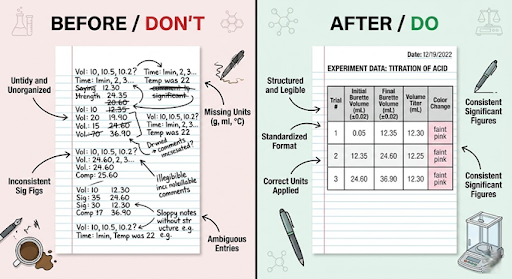
The “Results” section is the heart of your report. This is where most students lose marks—not because their experiment failed, but because their data presentation was messy.
| Component | What to Include | Common Mistake |
| Raw Data | Every measurement taken during the lab. | Deleting “outlier” data points. |
| Calculations | Step-by-step formulas used. | Skipping intermediate steps. |
| Significant Figures | Precise rounding based on equipment. | Using too many decimal places. |
| Units | Standard SI units (g, mol, L, K). | Forgetting to label axes or columns. |
Mastering Technical Complexity
Chemistry is unique because it requires a high level of symbolic literacy. You aren’t just writing words; you are balancing equations, drawing Lewis structures, and interpreting spectroscopic data. This technical barrier is often where undergraduates feel the most pressure.
When you encounter a particularly grueling set of organic synthesis problems or thermodynamic derivations, seeking specialized chemistry assignment help through Myassignmenthelp can bridge the gap between confusion and mastery. Having an expert break down the stoichiometry or the mechanism of a reaction ensures that your report remains accurate and reflects a deep understanding of the chemical principles involved, rather than just a surface-level description.
The Discussion: Interpreting the “Why”
The discussion section is where you prove you are a scientist. You must explain why your results occurred. If your yield was only 60%, don’t just say it was “human error.” Analyze the specific points of loss: Was it due to incomplete precipitation? Was there a side reaction?
Compare your findings to literature values. If the standard boiling point of your substance is $100^{\circ}C$ and you recorded $98^{\circ}C$, discuss the atmospheric pressure or impurities that might have caused the variance. This level of critical thinking is what separates a “pass” from an “excellent” grade.
Final Polish: Readability and E-E-A-T
To make your content rank well and remain readable, follow these three “Human-First” rules:
- Avoid Jargon Overload: While technical terms are necessary, explain them in context for your peers.
- Short Sentences: Scientific concepts are complex. Keep your sentences simple to ensure the logic isn’t lost.
- Visual Aids: Use clear tables (like the one above) and properly labeled graphs. A well-placed chart can replace five paragraphs of confusing text.
Frequently Asked Questions (FAQ)
Q1: How do I handle an experiment that “failed”?
Ans: A failed experiment is still a scientific result. In your report, accurately document what happened and use the discussion section to hypothesize why the expected results were not achieved. Scientists value honesty and analysis over “perfect” data.
Q2: What is the best way to cite sources in a lab report?
Ans: Most chemistry departments prefer the ACS (American Chemical Society) style. Always check your course handbook, as some may require APA or Harvard. Ensure every factual claim is backed by a textbook or peer-reviewed paper.
Q3: Can I use personal pronouns in a formal report?
Ans: Generally, no. Undergraduate science writing prioritizes a “passive voice” (e.g., “The solution was heated”) to emphasize the process over the person performing it.
Q4: How long should my discussion section be?
Ans: The discussion is usually the longest part of the report, often making up 30-40% of the total word count. It is the most important part of your academic evaluation.
Q5: Why are significant figures so important?
Ans: They represent the precision of your equipment. If your scale only measures to two decimal places, your final answer cannot have five decimal places. Over-precision is considered a scientific error.
About The Author
I am Mark Hales, an academic consultant and senior strategist at Myassignmenthelp, where I specialize in guiding undergraduate and graduate students through the complexities of STEM-based research and technical writing. With a background deeply rooted in scientific methodology, I am passionate about bridging the gap between high-level laboratory research and the rigorous standards of academic reporting.