You buy renters insurance because you want protection when life does not go as planned. A theft, apartment fire, burst pipe or other unexpected disaster can do more than damage your rental home. It can destroy the personal belongings you have collected over the years, including your laptop and furniture, your clothes and your everyday household items. Many renters believe that their insurance will simply pay to replace everything after a loss. But how much you get depends on how your policy values your belongings. That’s the difference between renters insurance replacement cost vs. actual cash value. The choice you make before a claim can have a major impact on your financial recovery later. One option focuses on helping you replace your belongings today, while the other considers what those items are worth after years of use.
What Is Replacement Cost Coverage in Renters Insurance?
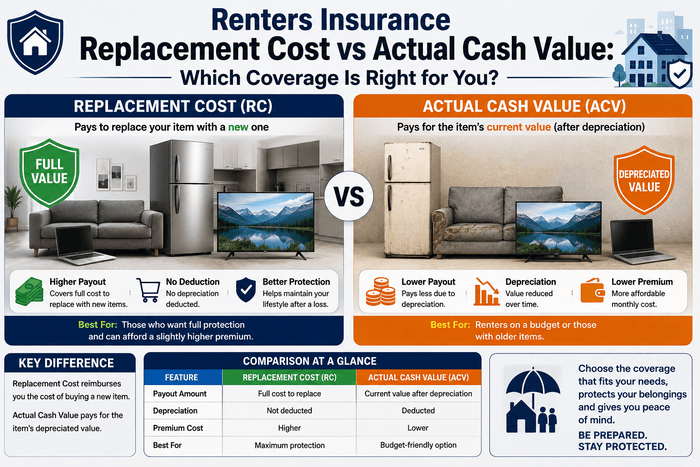
Renters insurance replacement cost coverage is intended to help you replace damaged or stolen property with similar new items without reducing the payout due to depreciation. Say, for example, someone takes your five-year-old laptop from your apartment. You paid $1,200 for it, but you could get a comparable model today for $900. If you have replacement cost coverage, your claim typically will be settled based on what it would cost to replace your laptop today, subject to your deductible, policy limits and the insurer’s rules.
The main advantage is that you are not left paying a large difference between the value of your old item and the price of a new replacement. This can make a big difference after a major loss because replacing your belongings all at once can become expensive very quickly. According to the Insurance Information Institute, many renters underestimate the total value of their personal belongings because they only think about their biggest purchases. In fact, if you replace furniture, clothing, electronics, kitchen items and personal equipment all together, it can easily add up to thousands of dollars.
What Is Actual Cash Value Coverage?
Actual cash value coverage is different. It factors depreciation into the calculation of your claim payment. Depreciation is the loss of value of your property due to the effects of age, use and normal wear and tear. Your insurance company looks at what an item was worth at the time of the loss rather than what it would cost to buy a new replacement.
For example, if your eight-year-old sofa originally cost $1,500, it may not be worth anywhere near that amount today. With a cash value policy, you could get paid the current value of the sofa, after depreciation, not the cost to buy a similar new sofa. It can reduce your monthly insurance cost, but it also means you may need to use your own money to cover the difference when replacing your belongings.
Why the Difference Matters After a Real Loss
The difference between these two options becomes clear when you experience a real claim situation. Suppose you go away for the weekend and come home to a flooded apartment. A pipe burst and water destroyed your furniture, electronics, clothes and personal effects. You make a list of everything that needs to be replaced and the total cost is about $7,000. However, because many of those items are several years old, their current value may be much lower.
With actual cash value coverage, your insurance company may determine the payment after factoring in depreciation. Your old television, furniture and electronics may not be worth enough to replace with the same items. Replacement cost coverage renters insurance is more concerned with how much it would cost you to replace those items with similar ones today. You still need to consider your deductible and coverage limits, but the financial gap is often smaller.
How Depreciation Can Affect Your Claim
Depreciation is one of the biggest reasons renters are surprised by their insurance payout. Tech moves so fast that a laptop that is working fine can lose a lot of value. A smartphone you paid hundreds of dollars for a few years ago might be worth a lot less today. The same is true for furniture. It loses value over time even if it’s still in good shape.Clothing is another example many renters overlook. After a fire or major water damage, replacing an entire wardrobe can cost much more than the used value of those clothes. The same applies to shoes, kitchen equipment, home office items, and hobby supplies. When you choose actual cash value coverage, you are accepting that depreciation will play a role in determining your payout.
Is Actual Cash Value Renters Insurance a Bad Option?
Actual cash value is not always the wrong choice. That can be a pragmatic choice for some renters. If you live in a small apartment, own few possessions or just want basic coverage at a lower cost, a lower-cost actual cash value policy might be fine for you. Some renters choose to pay a lower monthly premium and are comfortable paying more out-of-pocket after a claim. The key is that you understand the tradeoff. You might save money on your premium today, but if you have to replace your stuff later, you could end up paying more out of your own pocket.
When Replacement Cost Coverage Might Be a Good Idea
If you would have a hard time replacing your stuff without putting a strain on your finances, you might want to consider replacement cost coverage. Think about everything you use in your daily life. Your computer may be essential for work. Your furniture may have taken years to build. Your tools, camera equipment, gaming setup, or other personal items may represent a significant investment. Ask yourself a simple question: if everything inside your rental disappeared tomorrow, could you afford to replace it without creating financial pressure? If the answer is no, replacement cost claim may provide more peace of mind because it reduces the difference between what your belongings are worth today and what you need to buy after a loss.
How Your Claim Is Calculated by Insurance Companies
Many renters don’t realize that filing a claim is more than just telling the insurance company what was damaged. You need to show what happened and provide details of the loss. Then the insurer will decide if the situation is covered by your policy. Some documentation can help a lot to make this process easier. Photos of your possessions, receipts, purchase records and a simple home inventory can help prove ownership and value. If you have replacement cost coverage, the insurance company might pay you the actual cash value of your stuff, then pay you more after you replace the approved items. The actual process can depend on your insurance company and the terms of your policy.
Mistakes renters make when choosing coverage
One mistake renters often make is choosing a policy simply because it is the cheapest monthly. A cheaper policy may look attractive, but the real value of insurance appears when you need to file a claim. Another mistake is assuming your landlord’s insurance will protect your belongings. In most cases, your landlord’s policy covers the building itself, not your personal property inside the rental. Many renters also underestimate how much they own. They remember expensive items like a television or laptop but forget about smaller belongings such as clothing, kitchen supplies, bedding, decorations, and everyday equipment. These items can become surprisingly expensive when you need to replace everything at once.
How Much Personal Property Coverage Do You Need?
Before you determine how much coverage you should buy for your renters insurance, take a walk around your house and make a list of how much it would cost to replace your belongings. Don’t just think about your most valuable possessions. You’ll want to include furniture, electronics, clothing, appliances, personal items and things you use for work or hobbies in a realistic estimate. A home inventory can also help you understand your real replacement needs. Taking photos of your rooms and creating a simple list of valuable possessions can save you time and inconvenience if you have to file a claim.
Replacement Cost or Actual Cash Value: Which is Better?
What is best depends on what you have. What you can afford. How much financial risk you want to take. If you’re okay with a lower premium and understand that depreciation could result in a lower claim payment, actual cash value claim coverage can be a good option. Replacement cost coverage is often preferred by renters seeking increased protection and a better chance of replacing their belongings without the financial gap. The most important thing is knowing what your policy actually covers before you need it. Insurance is easier to evaluate when everything is fine, but the real test comes when you are trying to recover after an unexpected loss.
Frequently Asked Questions
Does replacement cost renters insurance pay more than actual cash value?
In many cases, yes. Replacement cost coverage usually pays more because it’s the cost of replacing the item, not what it’s worth after depreciation. Less than actual cash value Because: Actual cash value is what your stuff is worth today less depreciation for age, condition and normal wear.
Is stolen property covered by renter’s insurance?
Renters insurance usually covers theft, and how much you get depends on your coverage, policy limits, deductible, and whether your claim is approved.
Do you have to have receipts for everything you own?
No, but having pictures, receipts and documentation of your possessions can help the claims process easier and better evidence of ownership.
Do all renters insurance policies have replacement cost coverage?
Its availability will be based on the insurance company and the specific options that they have.
Final Thoughts
The difference between renters insurance replacement cost and actual cash value may seem like a small detail when you purchase a policy, but it can become a major financial difference after a loss. Actual cash value looks at what your belongings are worth today after depreciation. Replacement cost focuses on what it may take to replace those belongings with similar items. Before choosing your renters insurance claim payout, think about the life you have built inside your home and what it would cost to rebuild it after an unexpected event. The right coverage is not always the cheapest option, it is the one that gives you the protection you will actually need when things go wrong.